ESSAY · 27 October 2026 · 3 min read
How much will my hospital stay cost? Families deserve clarity in minutes
A rate card can list 2,000 prices and still not tell a family what its bill will be. Two steps would let a family compare hospitals within minutes, without any cap on prices.
First published in Mint · Power Point column
Read it on the Mint website (subscription required).
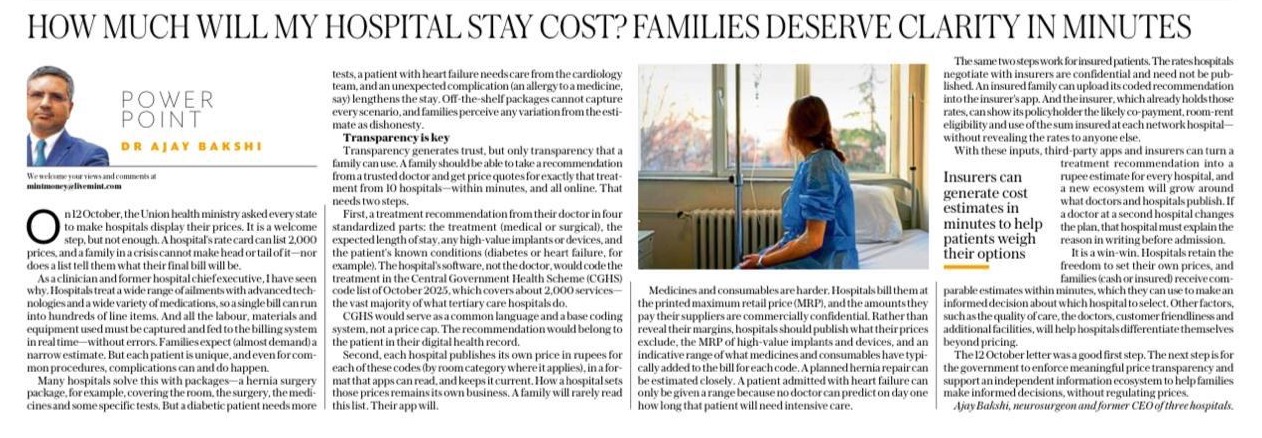
This column appeared in Mint on 27 October 2026, online under the headline "What will my hospital stay cost? Families deserve an answer in minutes". The clipping above shows the text as printed. What follows is a summary.
The problem
On 12 October 2026 the Union Health Ministry asked every state to make hospitals display their rates. The column calls this a welcome step, but not enough. A hospital's rate card can list 2,000 prices, and a list does not tell a family what the final bill will be.
Many hospitals offer packages, for example for a hernia repair. But a patient with diabetes needs more tests, a patient with heart failure needs the cardiology team, and a complication lengthens the stay. A package cannot cover every case, and families read any difference from the estimate as dishonesty.
Step one: a standard recommendation
The family's doctor writes the treatment recommendation in four standard parts: the treatment (medical or surgical), the expected length of stay, any high-value implants or devices, and the patient's known conditions. The hospital's software, not the doctor, codes the treatment against the CGHS code list of October 2025, which covers about 2,000 services. CGHS serves as a common language, not as a price cap. The recommendation belongs to the patient, in their digital health record.
Step two: prices that an app can read
Each hospital publishes its own price in rupees for each code (by room category where it applies), in a format that apps can read, and keeps it current. How a hospital sets those prices stays its own business. A family will rarely read this list. Its app will.
Medicines and consumables are harder, because hospitals bill them at the printed MRP and their purchase prices are confidential. The column proposes that hospitals publish three things instead: what their prices exclude, the MRP of high-value implants and devices, and the range that medicines and consumables have typically added to the bill for each code. A planned hernia repair can be estimated closely. A patient with heart failure can only be given a range.
Insured patients
Negotiated insurer rates stay confidential. The family uploads its coded recommendation to the insurer's app. The insurer already holds the rates, so it can show the likely co-payment, room-rent eligibility and use of the sum insured at each network hospital.
The outcome
With these inputs, apps and insurers can turn one recommendation into a rupee estimate for every hospital. If a doctor at a second hospital changes the plan, that hospital must explain the reason in writing before admission. Hospitals keep the freedom to set their own prices, and families get comparable estimates within minutes. Quality of care, the doctors and the facilities still set hospitals apart.
The column ends with the next step for the government: enforce meaningful price transparency and support an independent information ecosystem, without regulating prices.