Dr. Ajay Bakshi

From the notebooks

The Notebooks

Entries from a series of spiral notebooks, written between 2017 and 2022. Each page appears as written, corrections and open questions included, beside a plain transcript.

Transcripts follow the page. Abbreviations of the clinician's hand are expanded; a few marks of punctuation are supplied where the hand omits them; nothing else is edited.

i

Of Causality

3 January 2017 · complete in two pages

First handwritten page of the Of Causality entry, dated 3 January 2017.
Second handwritten page of the Of Causality entry, ending with the question: whats your causal model?

Transcript

  • Causality is one of the basic ingredients of the Universe which is fundamental — i.e not further divisible. Others are Space, Time & Matter-Energy. Using these 4, the entire universe can be constructed
  • Understanding of causality has evolved in animals. One might argue that starfish & sea anemone have no concept of causality — they simply are. However, a group of lions hunting down a zebra might understand the causality of making a sound & scaring the prey away. This becomes more refined in chimpanzees
  • Children begin to display understanding of causality quite early.
  • Adult humans have a need to build causal models to ‘explain’ the world. The veracity of the model is often unimportant. Absence of a causal model causes ‘mental stress’. Hence, religion exists. So does Science. In pop literature — everyone is searching for ‘meaning’ or ‘deeper purpose’ — all manifestations of a deep felt need for causal models
  • So strong is the need that the brain invents a post-hoc rationalization when the causal model is not obvious. In fact — with increasing complexity of modern technology & life in general — causality of many things we do is opaque. A lot of our behaviour is driven by culture & this manifests itself as our sub-conscious likes, dislikes, needs, wants etc.
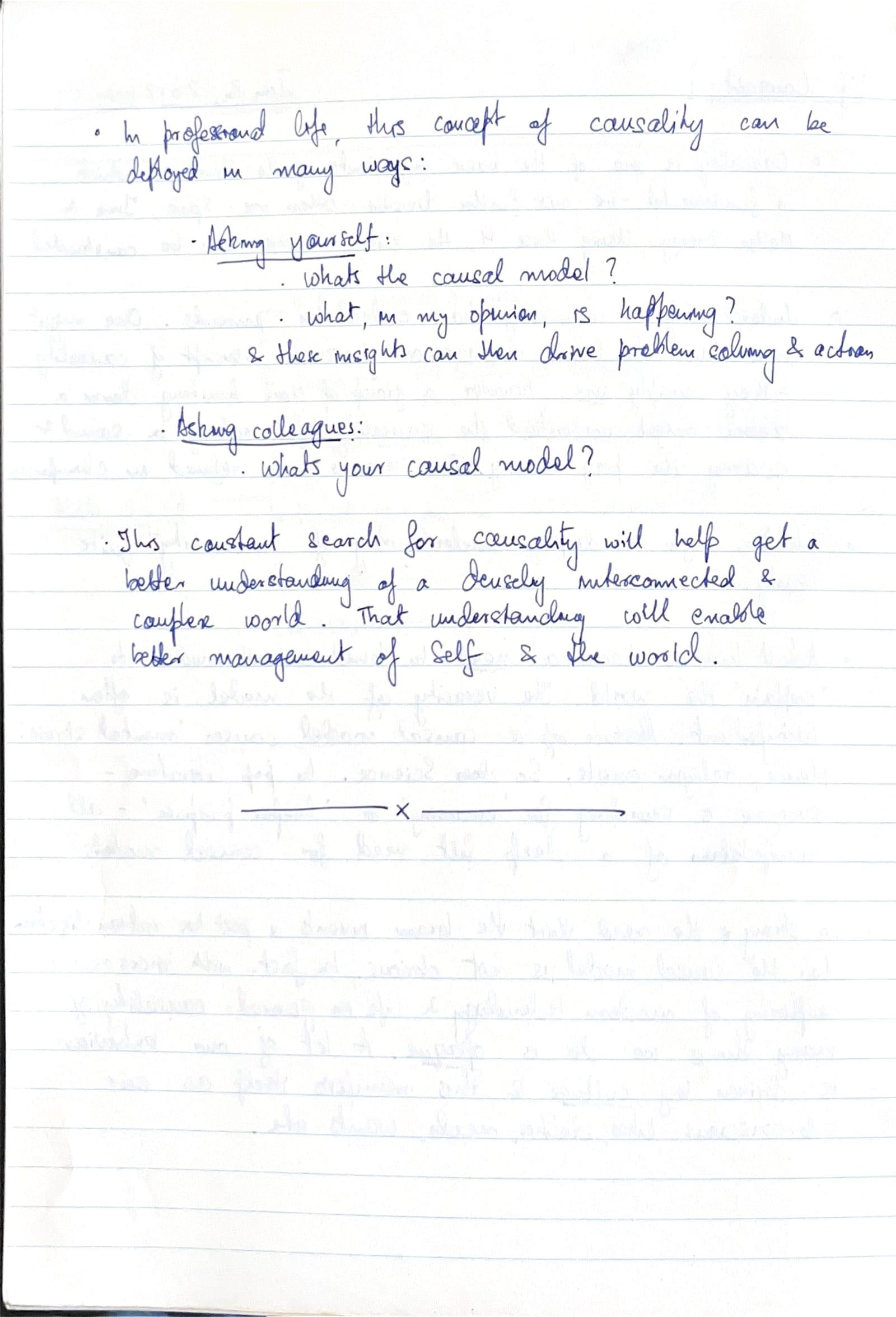
  • In professional life, this concept of causality can be deployed in many ways:
    • Asking yourself: Whats the causal model? What, in my opinion, is happening? & these insights can then drive problem solving & action
    • Asking colleagues: Whats your causal model?
  • This constant search for causality will help get a better understanding of a densely interconnected & complex world. That understanding will enable better management of Self & the world.

ii

Changing Sands of Time

6 November 2017 · the final page of a five-page entry

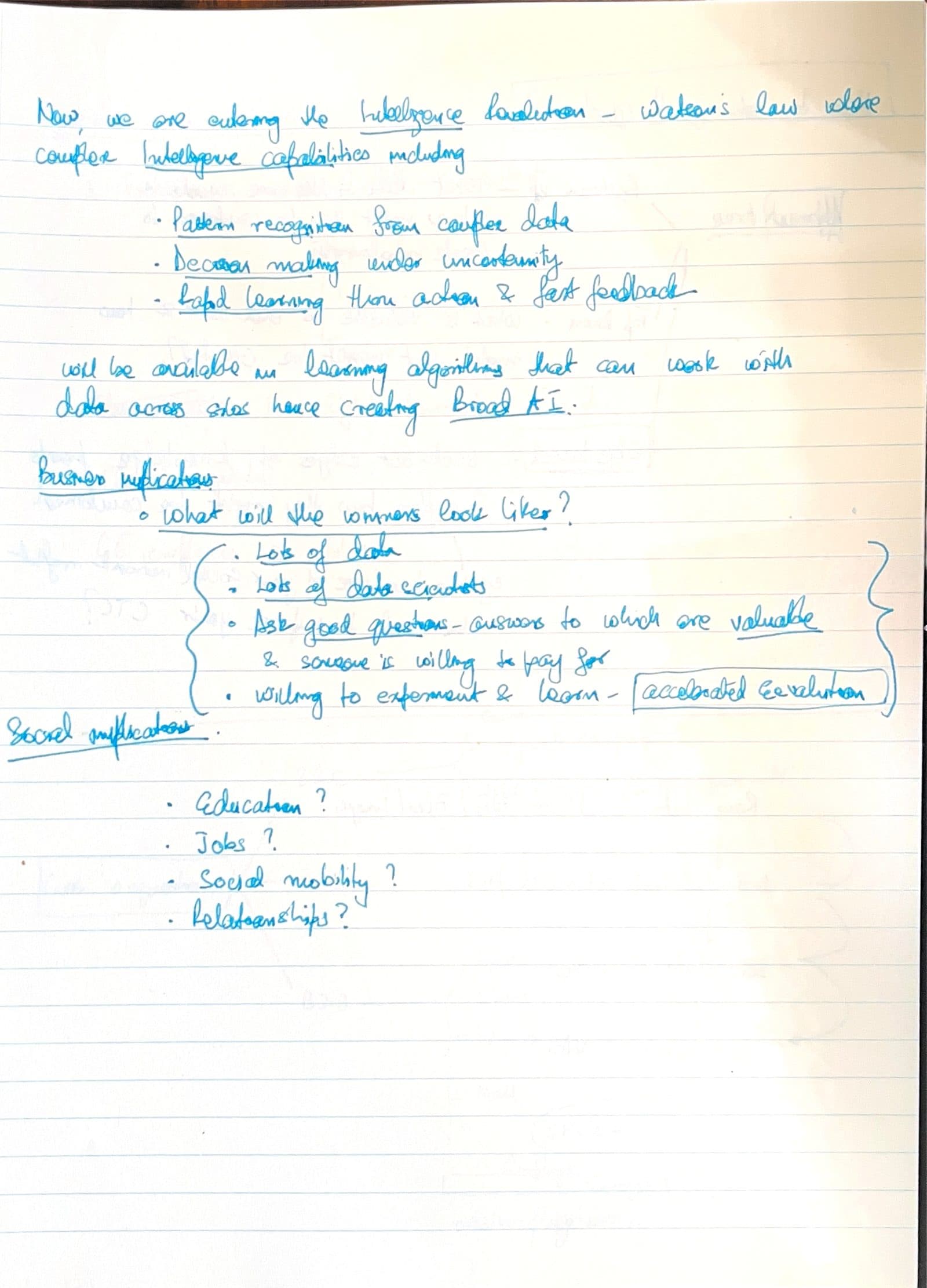
Handwritten notebook page dated November 2017, headed by the line: Now, we are entering the Intelligence Revolution.

Transcript

Now, we are entering the Intelligence Revolution— Watson's law where complex Intelligence capabilities including

  • Pattern recognition from complex data
  • Decision making under uncertainty
  • Rapid learning thru action & fast feedback

will be available in learning algorithms that can work with data across silos hence creating Broad AI.

Business implications

  • What will the winners look like?
    • Lots of data
    • Lots of data scientists
    • Ask good questions — answers to which are valuable & someone is willing to pay for
    • Willing to experiment & learn — accelerated evolution

Social implications

  • Education?
  • Jobs?
  • Social mobility?
  • Relationships?

iii

Non-striving is more effective than striving

16 November 2017 · the first page of a four-page entry

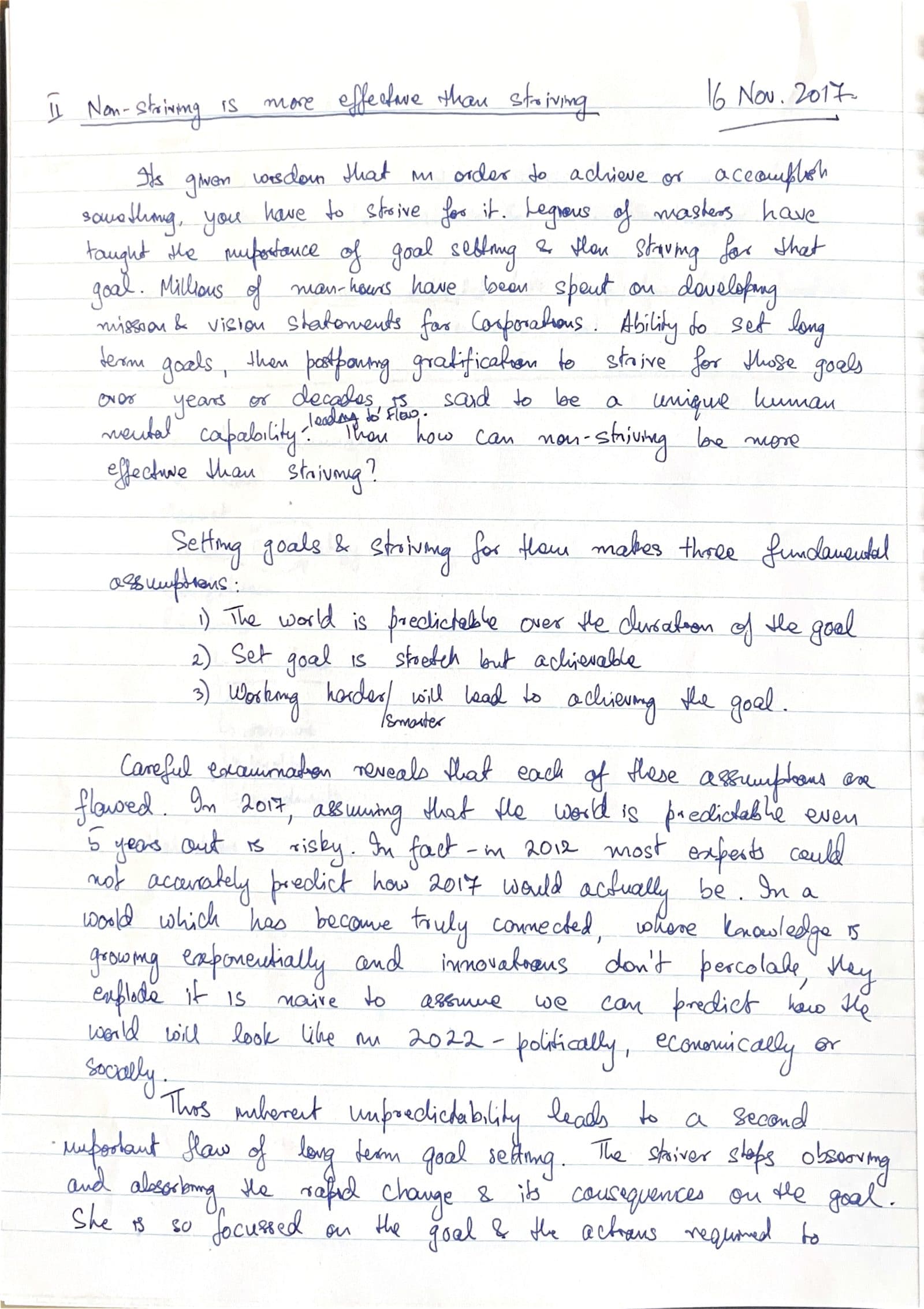
Handwritten notebook page dated 16 November 2017, titled: Non-striving is more effective than striving.

Transcript

Its given wisdom that in order to achieve or accomplish something, you have to strive for it. Legions of masters have taught the importance of goal setting & then striving for that goal. Millions of man-hours have been spent on developing mission & vision statements for corporations. Ability to set long term goals, then postponing gratification to strive for those goals over years or decades, is said to be a unique human mental capability — leading to ‘Flow’. Then how can non-striving be more effective than striving?

Setting goals & striving for them makes three fundamental assumptions:

  1. The world is predictable over the duration of the goal
  2. Set goal is stretch but achievable
  3. Working harder/smarter will lead to achieving the goal.

Careful examination reveals that each of these assumptions are flawed. In 2017, assuming that the world is predictable even 5 years out is risky. In fact — in 2012 most experts could not accurately predict how 2017 would actually be. In a world which has become truly connected, where knowledge is growing exponentially and innovations don't percolate, they explode, it is naive to assume we can predict how the world will look like in 2022 — politically, economically or socially.

This inherent unpredictability leads to a second important flaw of long term goal setting. The striver stops observing and absorbing the rapid change & its consequences on the goal. She is so focussed on the goal & the actions required to —

The remaining three pages
Second handwritten page of the Non-striving entry, on Ford, gas cars in 2022, and the three conditions of non-striving.
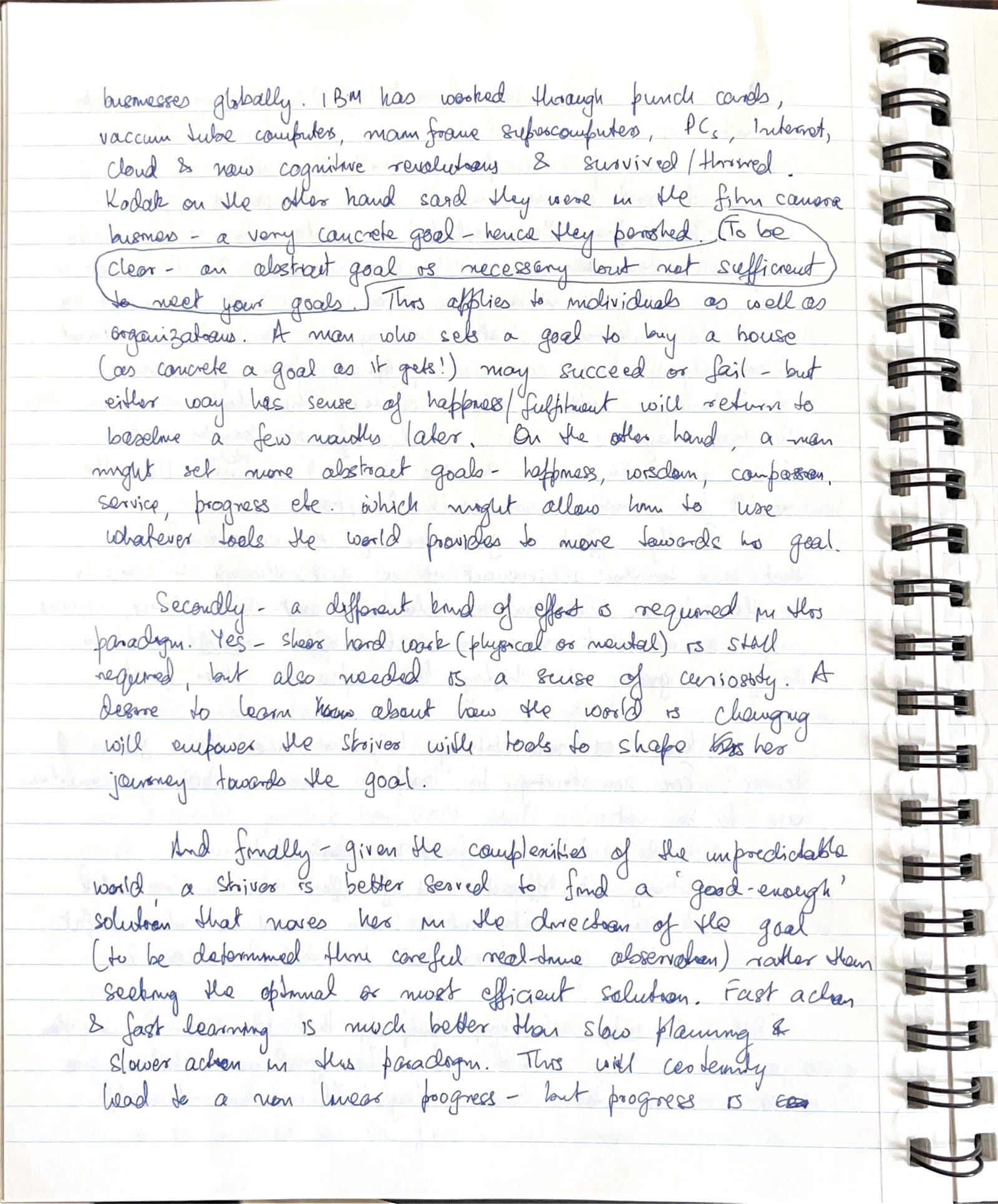
Third handwritten page of the Non-striving entry, on IBM, Kodak, and the different kind of effort non-striving requires.
Fourth handwritten page of the Non-striving entry, closing on evolution as the non-striving paradigm.

Transcript · continued

reach it, that any acknowledgement of the changing landscape is disturbing and deemed to be a distraction. But why should a changing landscape matter? It matters because if the actual world at the time for which the goal is set is very different from the predicted one — then the goal may be irrelevant, too easy or totally unachievable. If Ford set a goal of selling 10 million gas cars in 2022 & the world has moved to autonomous electric cars by then, its goal is irrelevant. Alternatively if large economies (e.g Africa) open up because of technologies (mobile, malaria vaccine) within that time frame, then the goal may be to low. Finally, if war/revolution breaks out in GCC — a probable scenario & gas becomes $200/barrel, then the market for 10 million cars could disappear.

Finally, effort is just one of the causal factors that lead to the achievement of a goal — though it seems to be the only one that can be voluntarily controlled. Hence, strivers might assume that more or better effort should lead to the goal — ignoring the shifting landscapes at their peril.

So, how does non-striving help overcome these flaws of striving? For non striving to lead to success, following conditions have to be met:

  1. Goals need to be defined in abstract terms
  2. Strong but different kind of effort needs to be exerted
  3. A willingness to experiment & learn is critical — which might result in a non-linear path to eventual success.

IBM is the only technology company that has survived more than 100 years in a very volatile sector. Their goal — an abstract one — is enshrined in their name: they build machines to help businesses globally. IBM has worked through punch cards, vaccum tube computers, mainframe supercomputers, PCs, Internet, Cloud & now cognitive revolutions & survived/thrived. Kodak on the other hand said they were in the film camera business — a very concrete goal — hence they perished. (To be clear — an abstract goal is necessary but not sufficient to meet your goals.) This applies to individuals as well as organizations. A man who sets a goal to buy a house (as concrete a goal as it gets!) may succeed or fail — but either way his sense of happiness/fulfilment will return to baseline a few months later. On the other hand, a man might set more abstract goals — happiness, wisdom, compassion, service, progress etc. which might allow him to use whatever tools the world provides to move towards his goal.

Secondly — a different kind of effort is required in this paradigm. Yes — sheer hard work (physical or mental) is still required, but also needed is a sense of curiosity. A desire to learn more about how the world is changing will empower the striver with tools to shape her journey towards the goal.

And finally — given the complexities of the unpredictable world a striver is better served to find a ‘good-enough’ solution that moves her in the direction of the goal (to be determined thru careful real-time observation) rather than seeking the optimal or most efficient solution. Fast action & fast learning is much better than slow planning & slower action in this paradigm. This will certainly lead to a non linear progress — but progress is much more likely. Hence a willingness to try, experiment, fail or not & learn is a key prerequisite of ‘non-striving’.

To summarize — non-striving does not mean no effort. Instead it implies reluctance to set concrete goals & replacing them with more abstract ones. Next it requires a sense of curiosity & fast action to move towards the abstract goal in a determined effortful way.

Finally, to close out the argument, it turns out that evolution — the most powerful force to shape our planet (& may be others) — follows the non striving paradigm! The abstract goal is gene-pool expansion & the means of achieving that change/improve with every generation. If the wonders of the human mind, complexity of the Amazon forest ecosystem and beauty of a flying swan can be created by ‘non-striving’, surely us mere mortals can accomplish greater things by adopting the non striving approach.

iv

What You See Is What You Seek

21 April 2018 · complete in two pages

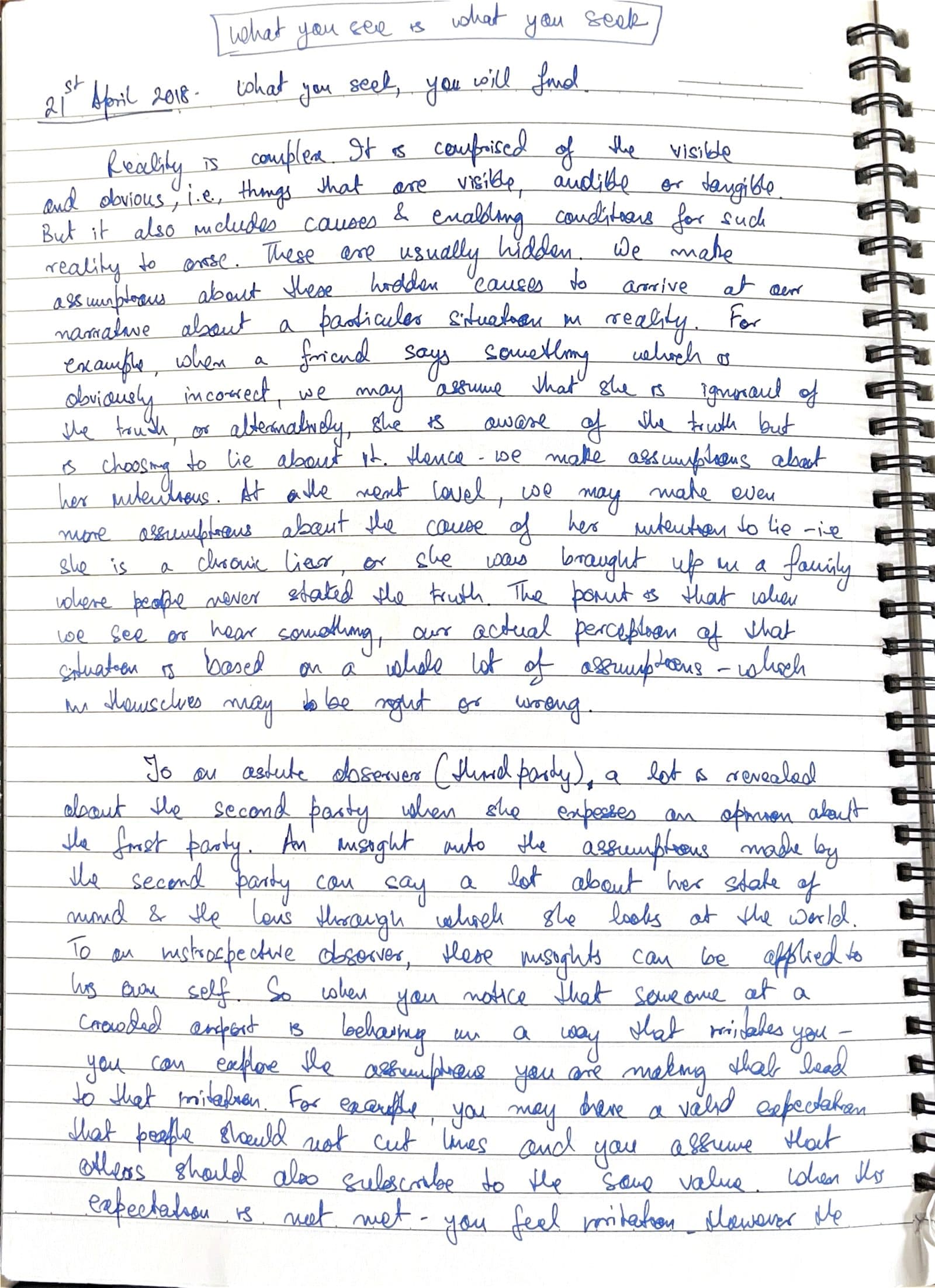
First handwritten page of the entry What you see is what you seek, dated 21 April 2018, with the subtitle: What you seek, you will find.
Second handwritten page of the entry What you see is what you seek, closing on the Rorschach test.

Transcript

What you seek, you will find.

Reality is complex. It is comprised of the visible and obvious, i.e., things that are visible, audible or tangible. But it also includes causes & enabling conditions for such reality to arise. These are usually hidden. We make assumptions about these hidden causes to arrive at our narrative about a particular situation in reality. For example, when a friend says something which is obviously incorrect, we may assume that she is ignorant of the truth, or alternatively, she is aware of the truth but is choosing to lie about it. Hence — we make assumptions about her intentions. At the next level, we may make even more assumptions about the cause of her intention to lie — i.e. she is a chronic liar, or she was brought up in a family where people never stated the truth. The point is that when we see or hear something, our actual perception of that situation is based on a whole lot of assumptions — which in themselves may be right or wrong.

To an astute observer (third party), a lot is revealed about the second party when she expresses an opinion about the first party. An insight into the assumptions made by the second party can say a lot about her state of mind & the lens through which she looks at the world. To an introspective observer, these insights can be applied to his own self. So when you notice that someone at a crowded airport is behaving in a way that irritates you — you can explore the assumptions you are making that lead to that irritation. For example, you may have a valid expectation that people should not cut lines and you assume that others should also subscribe to the same value. When this expectation is not met — you feel irritation. However the fairer [?] explanation may be that the line breaker has come from a social network where everyone breaks lines.

Another important consequence of this phenomenon (that reality is a construct of perceptions & assumptions about causes) is that people may see the same reality very differently. For example, when you see a hospital business that is struggling, your construct of reality may be summarized as ‘a terribly complex situation which is bad & difficult’. Alternatively the same set of facts may be summarized as ‘a great opportunity to improve’. Or, to put it more simply, you may choose to see the glass as half full or half empty. What you choose says a lot about your own mindset.

Even more importantly, and this is the main point of this essay, what you seek in a situation or person, most likely you will find it. As discussed earlier, situations & people's behaviour is complex — with multiple hidden causes & enabling conditions. Hence, if you seek goodness, opportunity, potential or any such quality in a situation — you will most certainly find it. The reverse is also true. The key question is ‘what do you seek?’ And the answer to that lies in what you see! This is a very useful & fundamental insight into our perceptions & how they are a window to our deeper, often invisible subconscious likes & dislikes & moral filters. So, in conclusion, the Rorschach test is not only an old psychological test; applying ‘what you see is what you seek’ to complex situations enables one to cut through the complexity by illuminating the underlying mental states & assumptions.

v

Philosophy of Knowledge

12 March 2019 · the closing page of a three-page entry titled On Causal Models

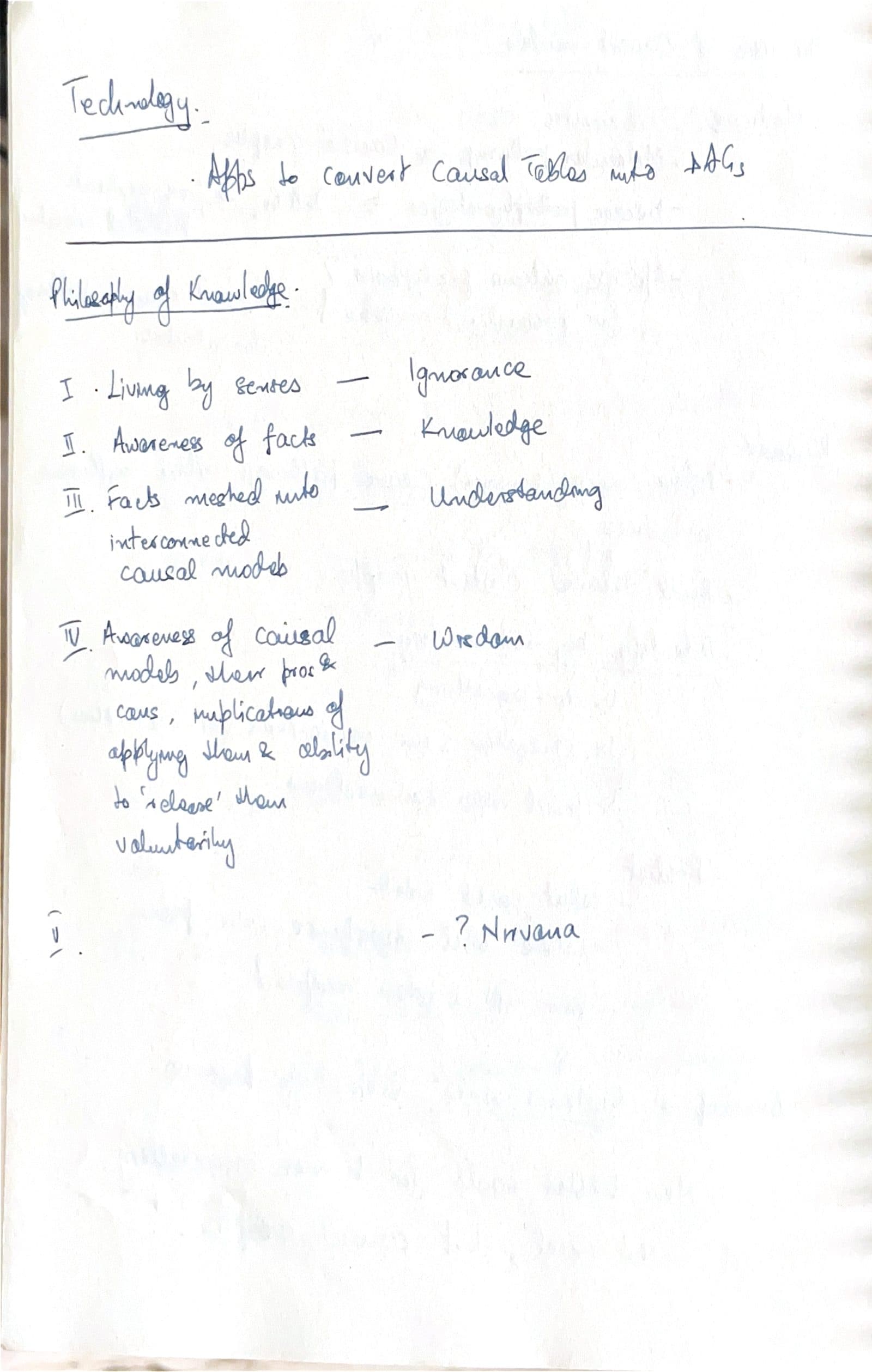
Handwritten notebook page from March 2019 with a five-step ladder from Ignorance to a question mark beside the word Nirvana.

Transcript

Technology

  • Apps to convert Causal Tables into DAGs

Philosophy of Knowledge

  1. Living by senses — Ignorance
  2. Awareness of facts — Knowledge
  3. Facts meshed into interconnected causal models — Understanding
  4. Awareness of causal models, their pros & cons, implications of applying them & ability to ‘release’ them voluntarily — Wisdom
  5. — ? Nirvana

vi

Art & Emotions

10 February 2022 · complete in three pages

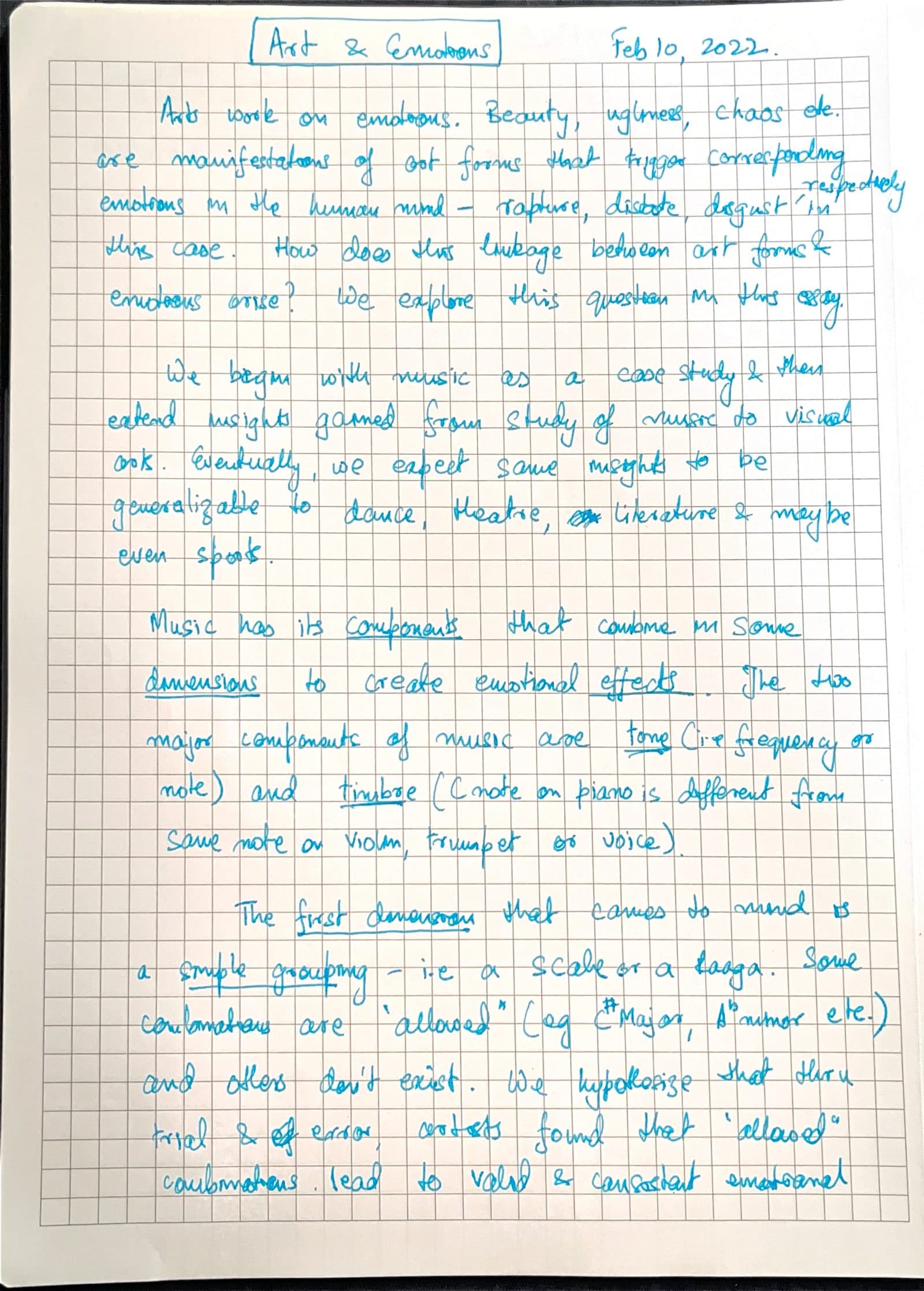
First handwritten page of the Art and Emotions entry, dated 10 February 2022, on squared paper.
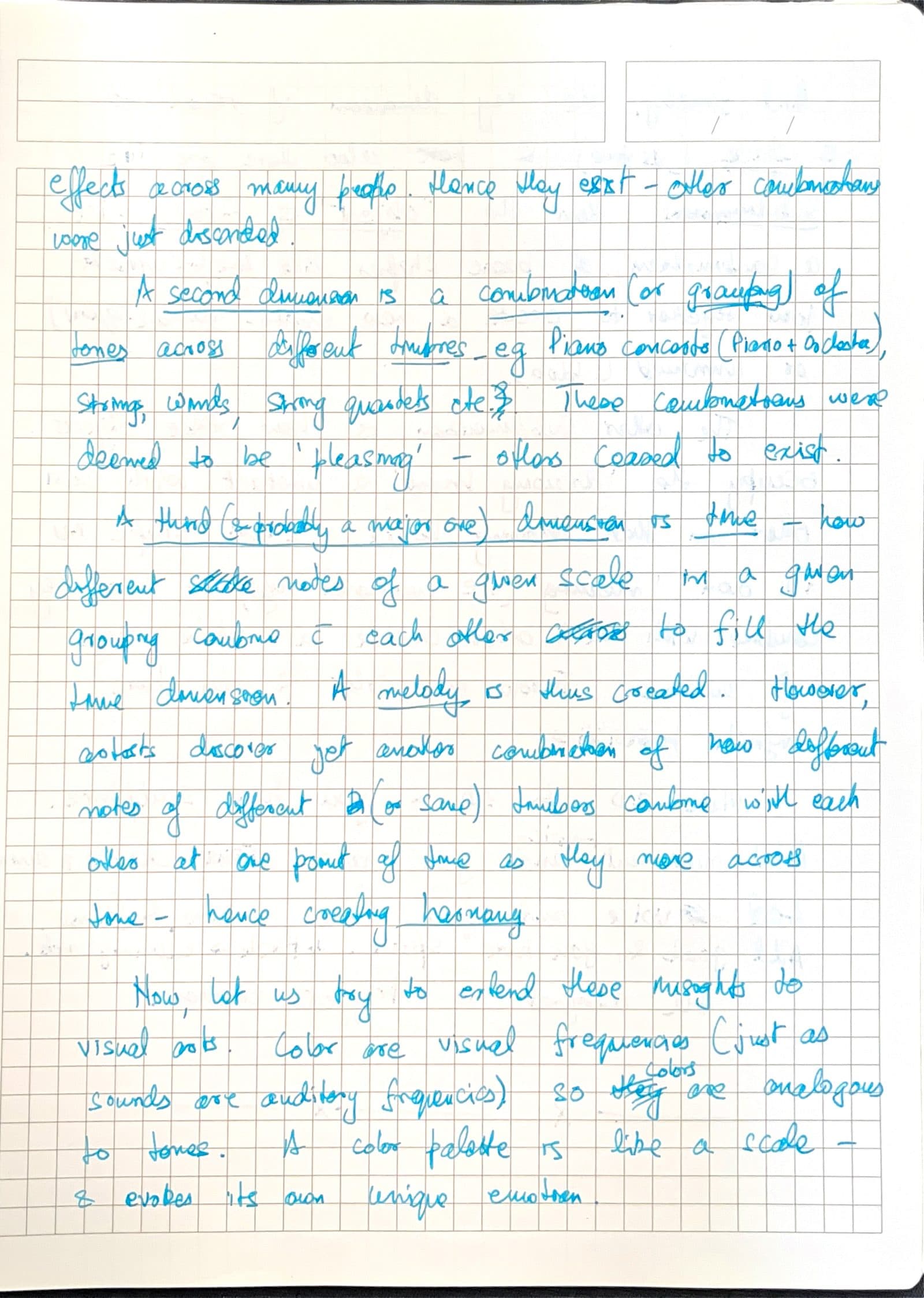
Second handwritten page of the Art and Emotions entry, on melody, harmony, and colors as visual frequencies.
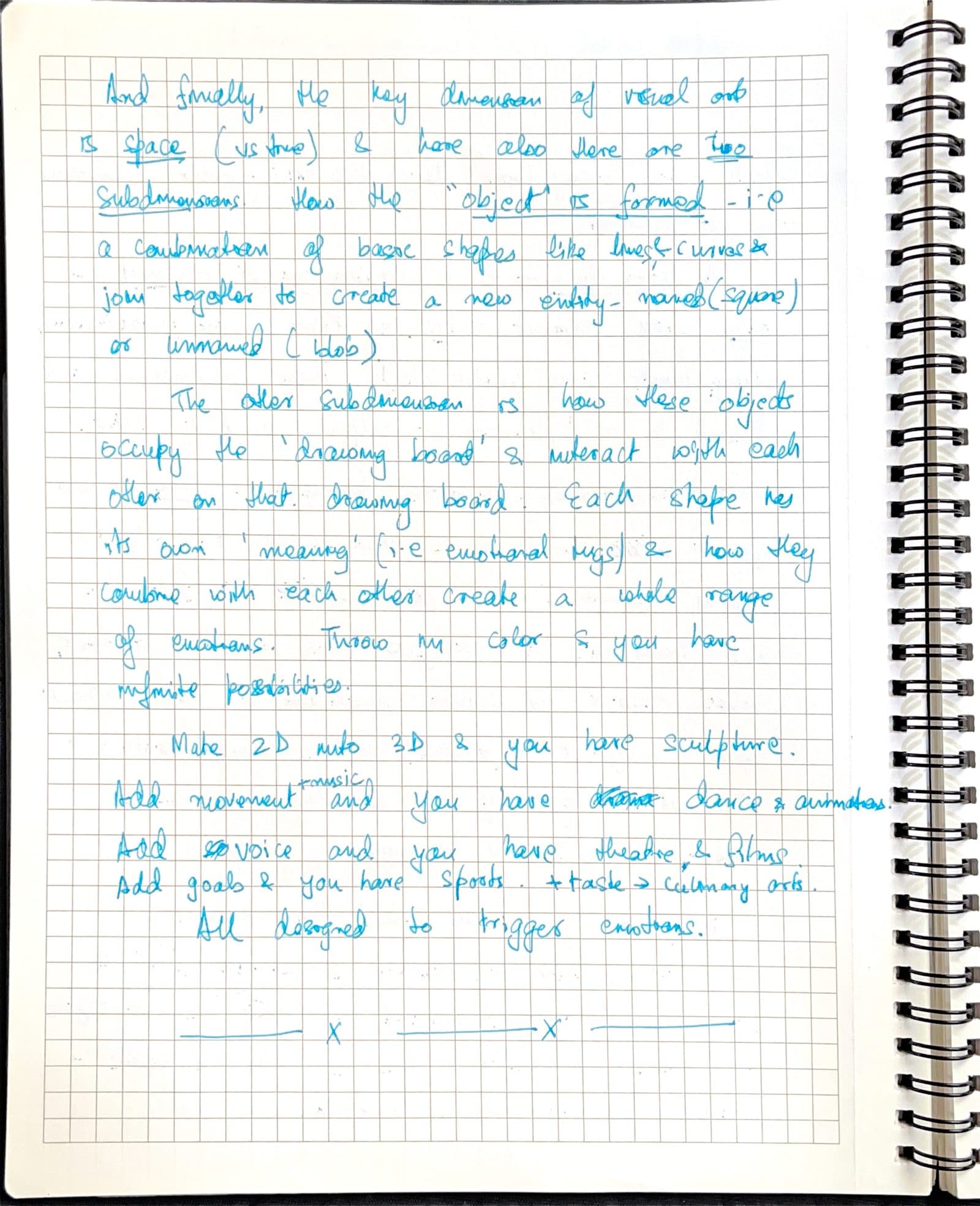
Third handwritten page of the Art and Emotions entry, ending: All designed to trigger emotions.

Transcript

Arts work on emotions. Beauty, ugliness, chaos etc. are manifestations of art forms that trigger corresponding emotions in the human mind — rapture, distaste, disgust respectively in this case. How does this linkage between art forms & emotions arise? We explore this question in this essay.

We begin with music as a case study & then extend insights gained from study of music to visual arts. Eventually, we expect same insights to be generalizable to dance, theatre, literature & maybe even sports.

Music has its components that combine in some dimensions to create emotional effects. The two major components of music are tone (i.e. frequency or note) and timbre (C note on piano is different from same note on violin, trumpet or voice).

The first dimension that comes to mind is a simple grouping— i.e. a scale or a raaga. Some combinations are ‘allowed’ (eg C♯ Major, A♭ minor etc.) and others don't exist. We hypothesize that thru trial & error, artists found that ‘allowed’ combinations lead to valid & consistent emotional effects across many people. Hence they exist — other combinations were just discarded.

A second dimension is a combination (or grouping) of tones across different timbres— eg Piano concerto (Piano + Orchestra), Strings, winds, string quartets etc. These combinations were deemed to be ‘pleasing’ — others ceased to exist.

A third (& probably a major one) dimension is time — how different notes of a given scale in a given grouping combine with each other to fill the time dimension. A melody is thus created. However, artists discover yet another combination — how different notes of different (or same) timbres combine with each other at one point of time as they move across time — hence creating harmony.

Now, let us try to extend these insights to visual arts. Colors are visual frequencies (just as sounds are auditory frequencies) so colors are analogous to tones. A color palette is like a scale — & evokes its own unique emotion.

And finally, the key dimension of visual art is space (vs time) & here also there are two subdimensions. How the ‘objectis formed— i.e. a combination of basic shapes like lines, curves & join together to create a new entity — named (square) or unnamed (blob).

The other subdimension is how these objects occupy the ‘drawing board’ & interact with each other on that drawing board. Each shape has its own ‘meaning’ (i.e. emotional tugs) & how they combine with each other create a whole range of emotions. Throw in color & you have infinite possibilities.

Make 2D into 3D & you have sculpture. Add movement + music and you have dance & animation. Add voice and you have theatre & films. Add goals & you have sports. + taste → culinary arts.

All designed to trigger emotions.

vii

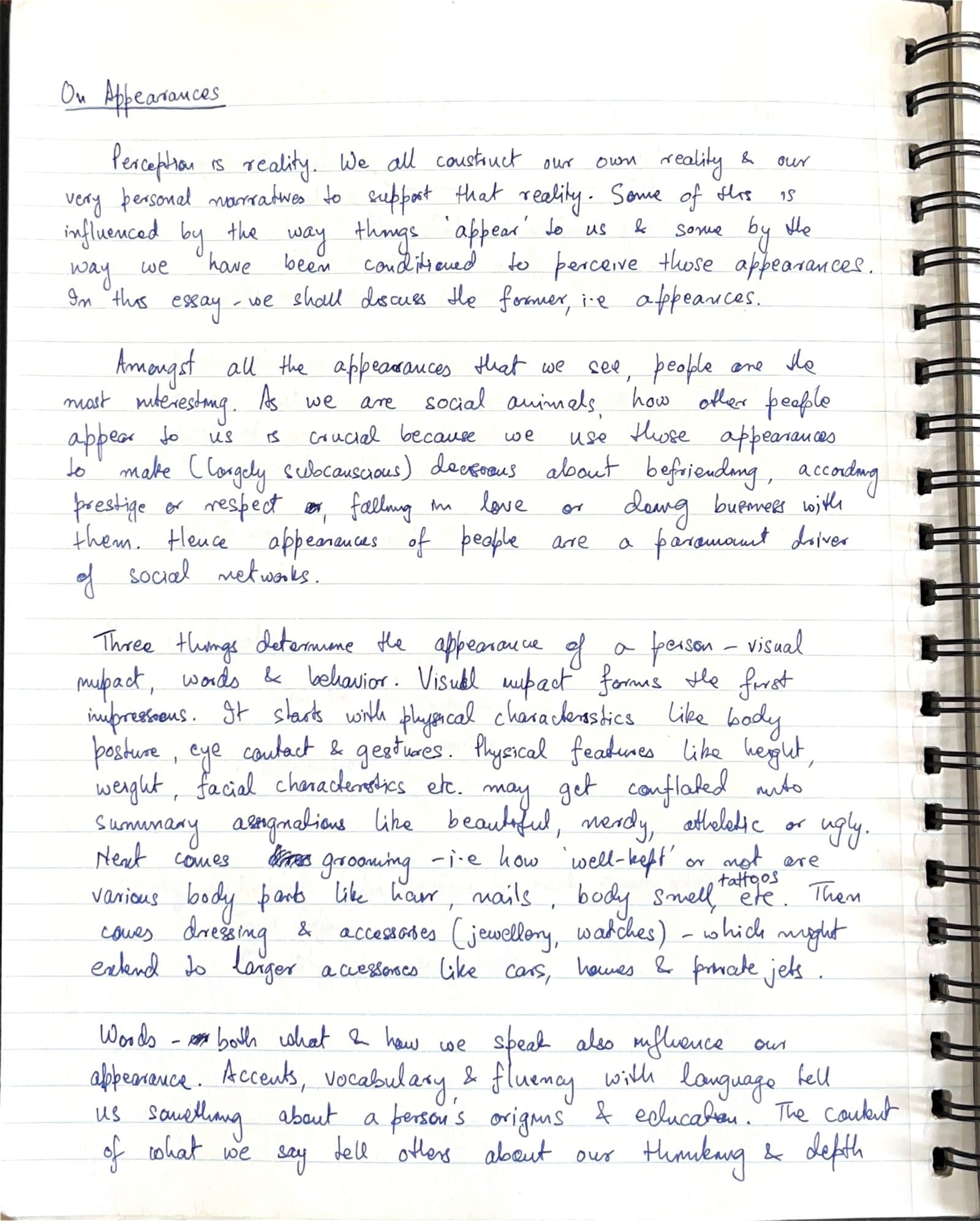
On Appearances

Undated · complete in three pages

First handwritten page of the On Appearances entry: perception is reality, and three things determine the appearance of a person.
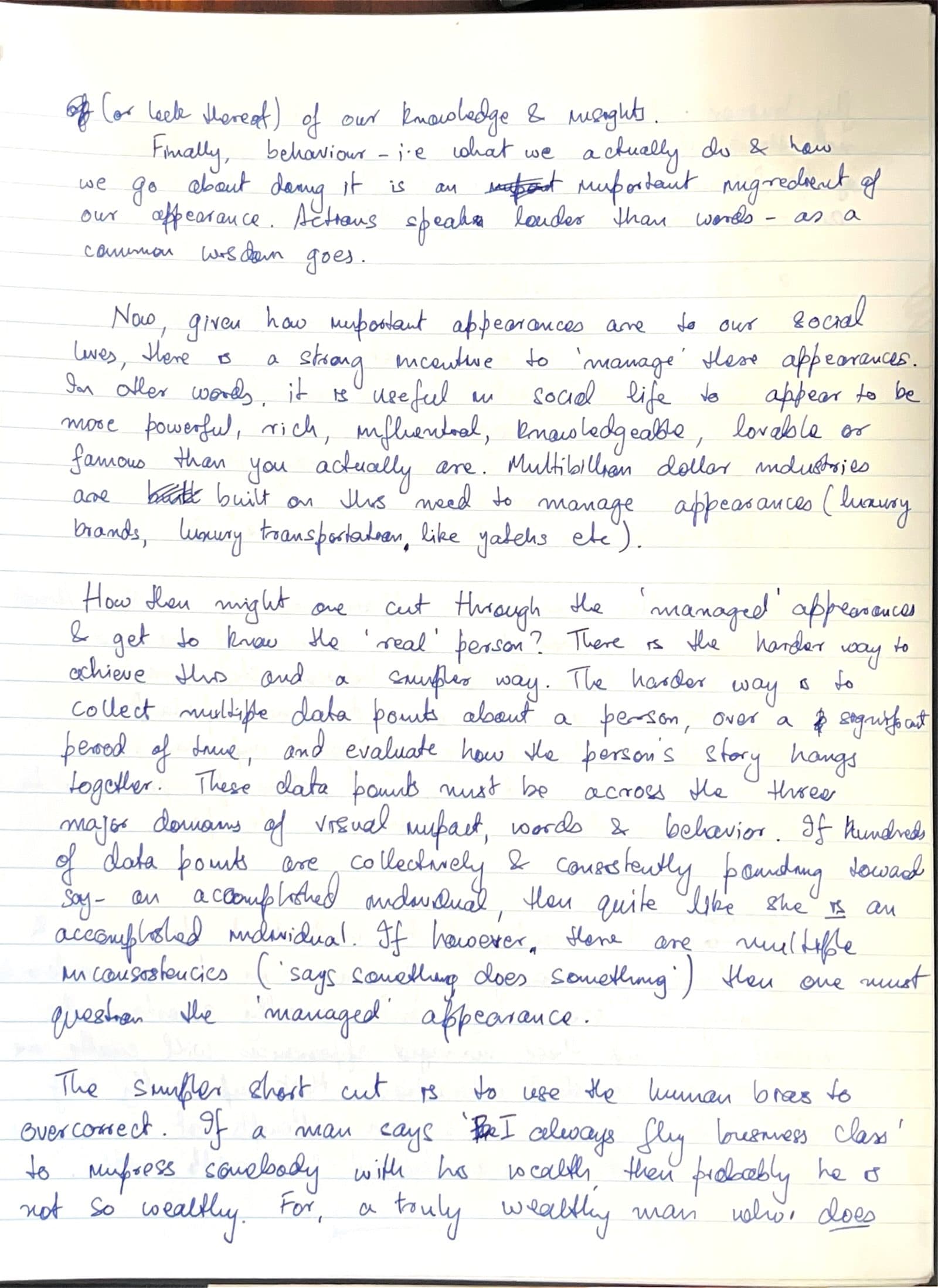
Second handwritten page of the On Appearances entry, on managed appearances and how to cut through them.
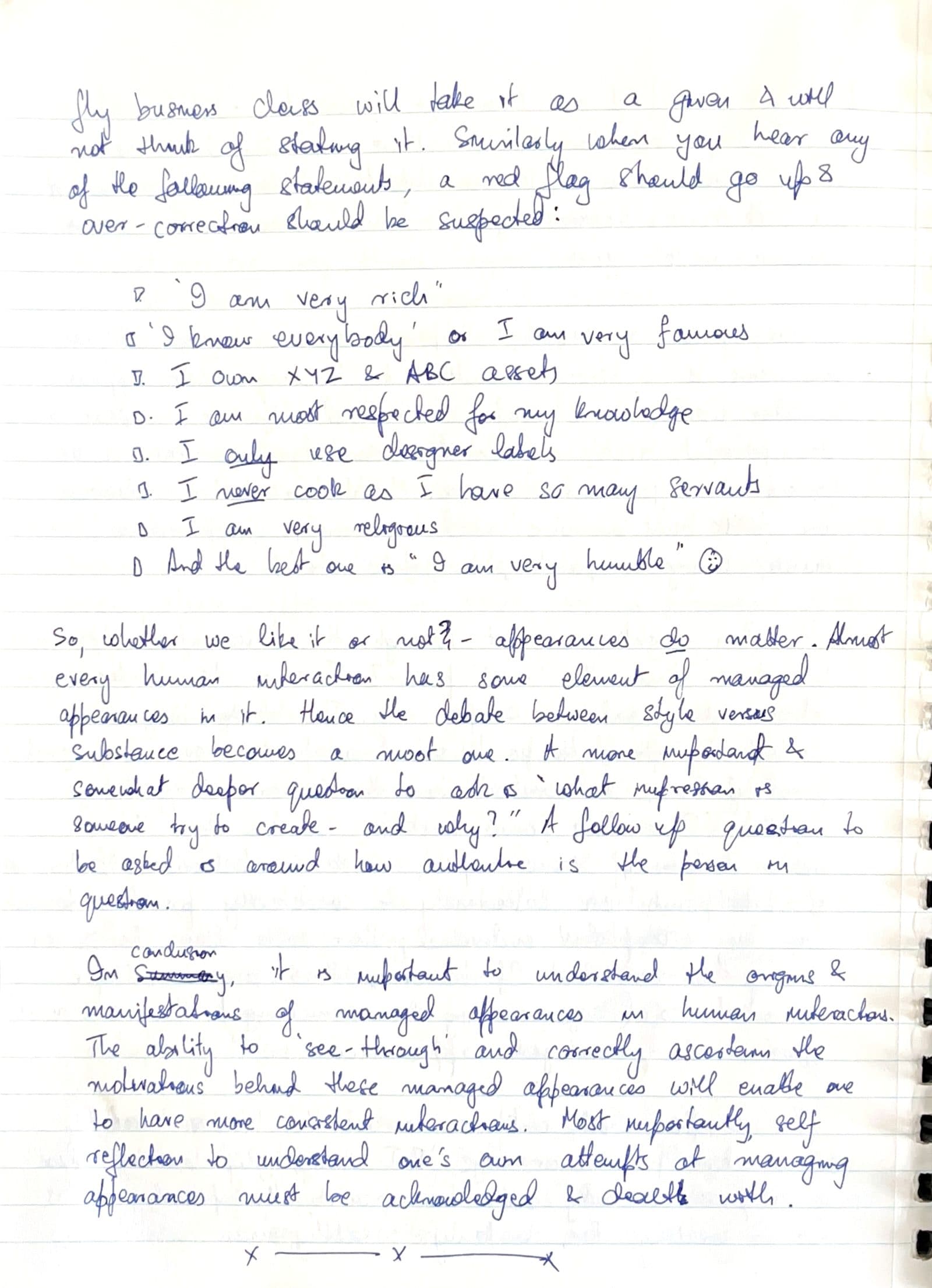
Third handwritten page of the On Appearances entry, with the red-flag list ending: and the best one is, I am very humble.

Transcript

Perception is reality. We all construct our own reality & our very personal narratives to support that reality. Some of this is influenced by the way things ‘appear’ to us & some by the way we have been conditioned to perceive those appearances. In this essay — we shall discuss the former, i.e appearances.

Amongst all the appearances that we see, people are the most interesting. As we are social animals, how other people appear to us is crucial because we use those appearances to make (largely subconscious) decisions about befriending, according prestige or respect, falling in love or doing business with them. Hence appearances of people are a paramount driver of social networks.

Three things determine the appearance of a person — visual impact, words & behavior. Visual impact forms the first impressions. It starts with physical characteristics like body posture, eye contact & gestures. Physical features like height, weight, facial characteristics etc. may get conflated into summary designations like beautiful, nerdy, athletic or ugly. Next comes grooming — i.e how ‘well-kept’ or not are various body parts like hair, nails, body smell, tattoos etc. Then comes dressing & accessories (jewellery, watches) — which might extend to larger accessories like cars, homes & private jets.

Words — both what & how we speak also influence our appearance. Accents, vocabulary & fluency with language tell us something about a person's origins & education. The content of what we say tell others about our thinking & depth (or lack thereof) of our knowledge & insights.

Finally, behaviour — i.e what we actually do & how we go about doing it is an important ingredient of our appearance. Actions speak louder than words — as a common wisdom goes.

Now, given how important appearances are to our social lives, there is a strong incentive to ‘manage’ these appearances. In other words, it is useful in social life to appear to be more powerful, rich, influential, knowledgeable, lovable or famous than you actually are. Multibillion dollar industries are built on this need to manage appearances (luxury brands, luxury transportation, like yachts etc).

How then might one cut through the ‘managed’ appearances & get to know the ‘real’ person? There is the harder way to achieve this and a simpler way. The harder way is to collect multiple data points about a person, over a significant period of time, and evaluate how the person's story hangs together. These data points must be across the three major domains of visual impact, words & behavior. If hundreds of data points are collectively & consistently pointing toward say — an accomplished individual, then quite likely she is an accomplished individual. If however, there are multiple inconsistencies (‘says something does something’) then one must question the ‘managed’ appearance.

The simpler short cut is to use the human bias to overcorrect. If a man says ‘I always fly business class’ to impress somebody with his wealth, then probably he is not so wealthy. For, a truly wealthy man who does fly business class will take it as a given & will not think of stating it. Similarly when you hear any of the following statements, a red flag should go up & over-correction should be suspected:

  • ‘I am very rich’
  • ‘I know everybody’ or I am very famous
  • I own XYZ & ABC assets
  • I am most respected for my knowledge
  • I only use designer labels
  • I never cook as I have so many servants
  • I am very religious
  • And the best one is ‘I am very humble’ ☺

So, whether we like it or not — appearances do matter. Almost every human interaction has some element of managed appearances in it. Hence the debate between style versus substance becomes a moot one. A more important & somewhat deeper question to ask is ‘what impression is someone trying to create — and why?’ A follow up question to be asked is around how authentic is the person in question.

In conclusion, it is important to understand the origins & manifestations of managed appearances in human interactions. The ability to ‘see-through’ and correctly ascertain the motivations behind these managed appearances will enable one to have more consistent interactions. Most importantly, self reflection to understand one's own attempts at managing appearances must be acknowledged & dealt with.

viii

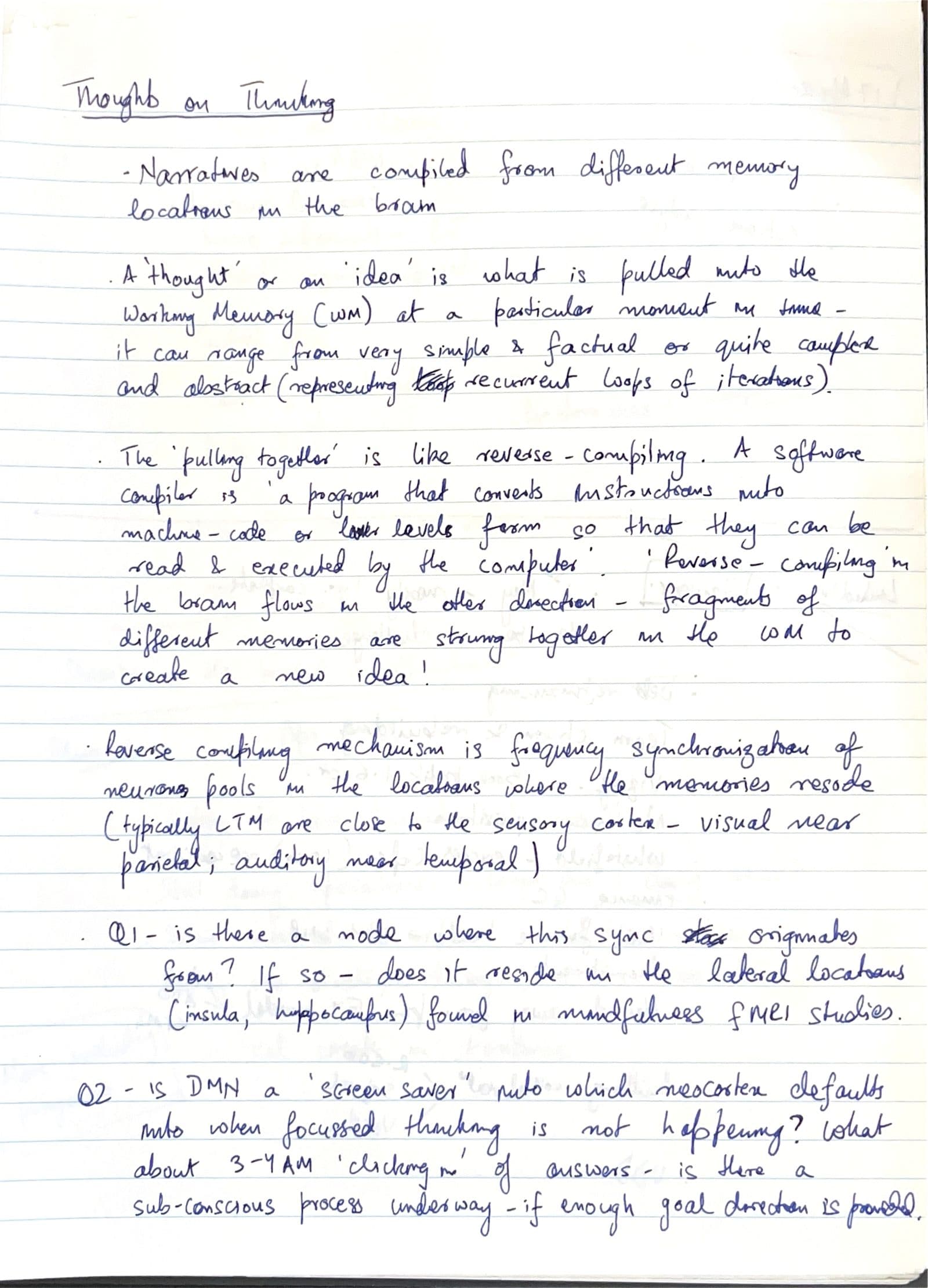
Thoughts on Thinking

Undated

Handwritten notebook page titled Thoughts on Thinking, with bullet notes and two numbered research questions.

Transcript

  • Narratives are compiled from different memory locations in the brain
  • A ‘thought’ or an ‘idea’ is what is pulled into the Working Memory (WM) at a particular moment in time — it can range from very simple & factual or quite complex and abstract (representing recurrent loops of iterations).
  • The ‘pulling together’ is like reverse-compiling. A software compiler is ‘a program that converts instructions into machine-code or lower levels form so that they can be read & executed by the computer’. ‘Reverse-compiling’ in the brain flows in the other direction — fragments of different memories are strung together in the WM to create a new idea!
  • Reverse compiling mechanism is frequency synchronization of neuronal pools in the locations where the memories reside (typically LTM are close to the sensory cortex — visual near parietal; auditory near temporal)
  • Q1 — is there a node where this sync originates from? If so — does it reside in the lateral locations (insula, hippocampus) found in mindfulness fMRI studies.
  • Q2 — is DMN a ‘screen saver’ into which neocortex defaults into when focussed thinking is not happening? What about 3–4 AM ‘clicking in’ of answers — is there a sub-conscious process underway — if enough goal direction is provided.

ix

Life as a Series of Choices

Undated · the list ends where the page does

Handwritten notebook page titled Life as a series of choices, ending in a dated list of decisions from 1980 to 1990.

Transcript

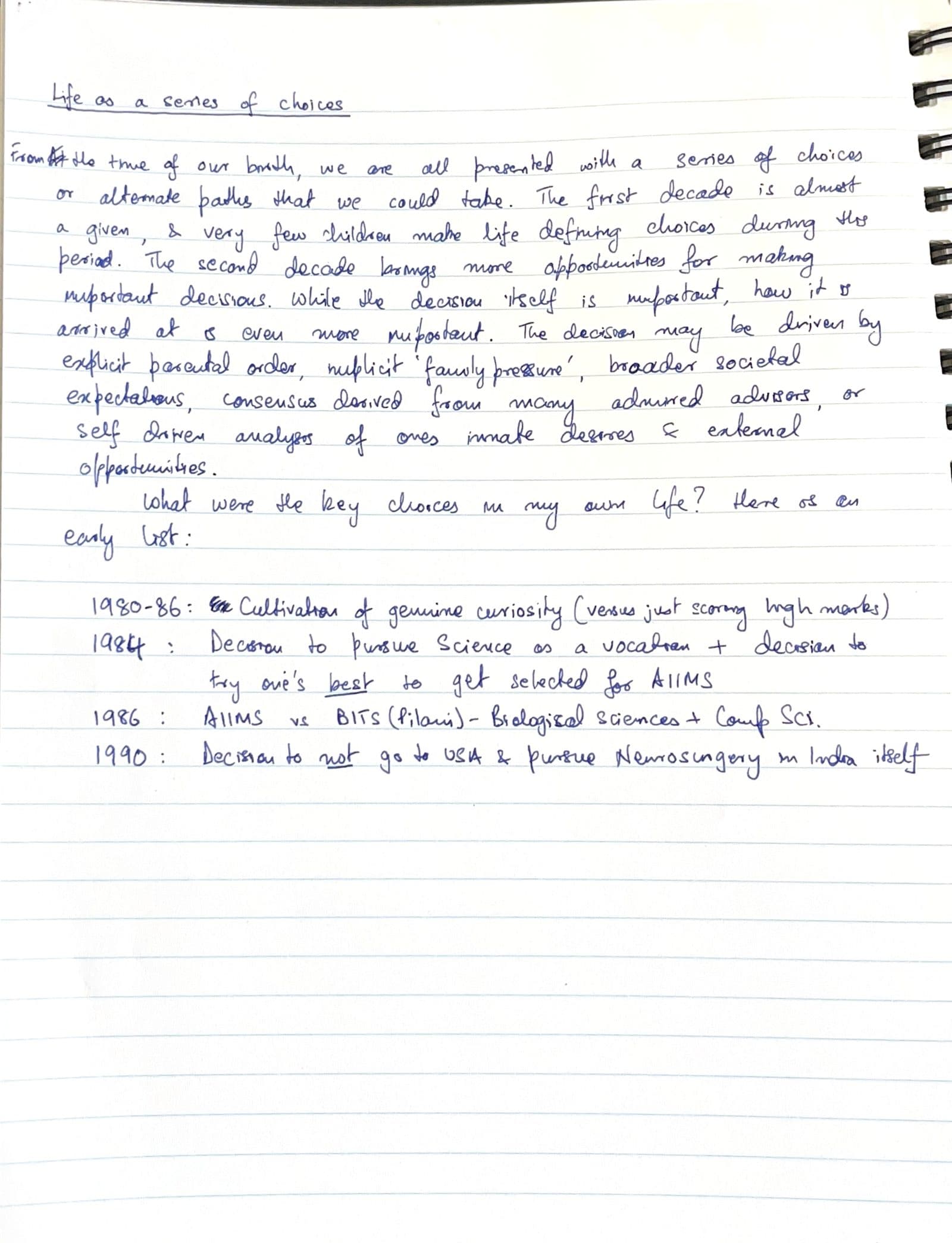
From the time of our birth, we are all presented with a series of choices or alternate paths that we could take. The first decade is almost a given, & very few children make life defining choices during this period. The second decade brings more opportunities for making important decisions. While the decision itself is important, how it is arrived at is even more important. The decision may be driven by explicit parental order, implicit ‘family pressure’, broader societal expectations, consensus derived from many admired advisors, or self driven analysis of ones innate desires & external opportunities.

What were the key choices in my own life? Here is an early list:

  • 1980–86: Cultivation of genuine curiosity (versus just scoring high marks)
  • 1984: Decision to pursue Science as a vocation + decision to try one's best to get selected for AIIMS
  • 1986: AIIMS vs BITS (Pilani) — Biological Sciences + Comp Sci.
  • 1990: Decision to not go to USA & pursue Neurosurgery in India itself